
According to 23andMe, I am around 14 percent Greek. I’m from a small fishing village, like my cousin Balki. The number keeps changing as more and more people spit into tubes and send them away.
Growing up, my father’s side was Greek. It was also the only side of the family that really made it over here, so we were Greek in a big way. Greek culture is family and food, and there is no real separation between the two. It was my inherited and adopted nationality, besides being first and always a proud American.
Since my parents passed, I have been one giant bag of feelings, sentiment, emotion, and nostalgia.
My father kindly accepted my mother’s Lutheran religion, and that was how their boys were brought up. To be fair, there wasn’t a Greek Orthodox church in the area when we were growing up. My parents were also always on the late side. We were lucky to make the Sunday service in Newtown. There is no way my mother would have handled the tour de force of Orthodox Christianity—hours of standing and prayer, a good deal of it in Greek.
But after attending the funerals of my Yia Yia and my Aunt Mary, my mother became convinced that the Greek Orthodox Church was for her.
She wanted to be known. She wanted her eulogy to be given by someone who knew her and cared about her. Father Peter was her man, whether he knew it or not.
My father was very happy to be going back home.
I can only imagine the questions and questions my mother asked Father Peter as she went through the catechumenate and was finally chrismated into the faith. He literally needed the patience of a saint.
I think of 1 Corinthians 13:12:
“Now I know in part; then I shall know fully, even as I am fully known.”
That verse has taken on a new meaning for me as a father, looking back while my daughter is graduating from high school and my son is graduating from middle school.
The love that pours out of a father for his son and daughter is almost impossible to explain. Recently, I found myself thinking about how differently that love is experienced on each side. A parent carries the whole history—the years, the worry, the sacrifices, the ordinary days that somehow become sacred when you look back on them. A child is simply living inside it.
For a moment, that realization made me melancholy. Not because the love was not returned, but because it could never be fully understood in the same way. They could not see it from where I was standing, just as I could not fully see the love of my own parents while they were still here.
Then I thought again about the verse and realized that we are never going to be fully known down here. We can’t be. Maybe it is a mistake to expect another person to understand every part of the love we carry for them.
But the desire itself is true. We want to be fully loved. We want to be known and loved in all the strange and particular ways that each individual person needs love.
It became another lightbulb moment about God. Maybe the question is not simply whether we love God, but whether we will allow ourselves to be loved by Him. Jesus asks the crippled man if he wants to be healed. Love does not force itself upon us. It asks to be accepted.
I am extremely grateful to Father Peter and Father Nikolas for their love and kindness when my parents passed. They took the time to know them, and that gave me peace. In those moments, the garments of the Christian faith began to mean something different to me. Worn honestly, they represented men trying to place their trust in love and allow it to guide them.
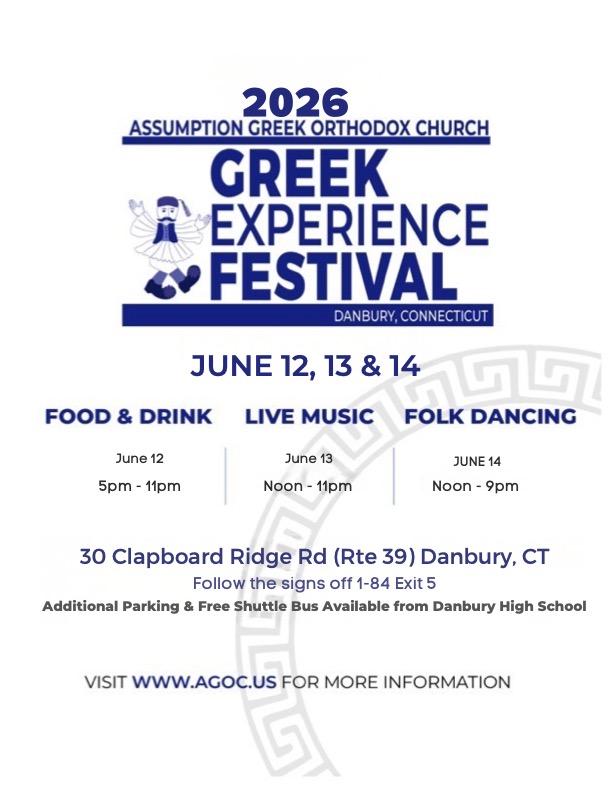
All of this, and what about the Greek Experience?
To understand the festival, I think you have to understand the Greek instinct to work together, feed everyone, support the church, and somehow enjoy the chaos of doing all four at the same time.
And then there is the food.
The food is pretty amazing. How could it not be when you have all the Greeks who run the diners and food businesses in the area working together.
I know the McDonald brothers and Ray Kroc developed the modern quick-service restaurant model, but I have no doubt they were divinely inspired after watching Greeks run a church festival somewhere in California.
That is what my father loved about it. Not just the gyros and all the great food, although he certainly loved the gyros. He loved the work, the organization, and the people stepping in wherever they were needed. To him, faith was not only something spoken about on Sunday morning. It was something built, cooked, served, cleaned up, and then done all over again the next year.
For me, the festival is impossible to separate from my parents. It reminds me of my father being proud of his Greekness, my mother asking Father Peter enough questions to test the patience of heaven, and all the strange ways that funerals, faith, food, and laughter become tied together. It also reminds me of all the people we loved who are no longer standing beside us in line.
So I sat there eating a gyro, looking at the icons, watching everyone work, and thinking about my father.
For a little while, he did not feel very far away.
That is a pretty amazing experience for someone who is 14 percent Greek.


Leave a Reply